
Last updated
How many restrooms does a race in Racine need?
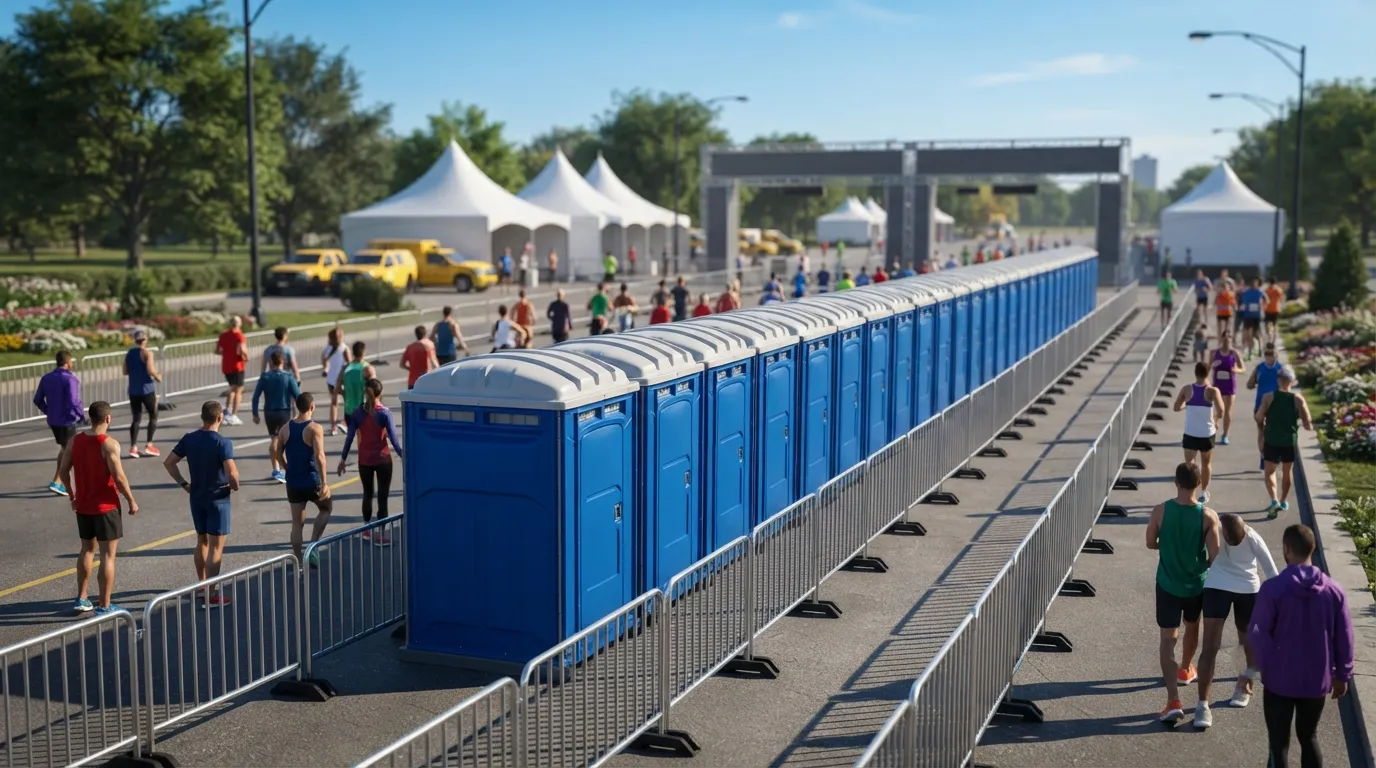
Runner count drives the number, but so does your course shape. A loop course lets you cluster units at one aid station near the start-finish; an out-and-back point-to-point route through Racine needs restrooms staged at two or three separate spots, which usually means splitting your order across standard porta potty rental units and a smaller cluster near the finish chute. OSHA 1926.51(c) sets construction-crew ratios, not race-day crowd ratios, but organizers use it as a rough sanity check: it calls for 1 toilet for every 20 workers, scaling up from there. For a public race, most experienced organizers plan tighter than that because runners hit the restrooms in waves right before the gun and right after they cross the line, not steadily through the day. A porta potty rental in Racine sized for 500 to 1,000 runners typically lands in the 10-to-16-unit range once you add a water station or two. Ask your vendor about a handwashing station rental near any food or hydration tables too, since ANSI/PSAI Z4.3 treats servicing intervals as a baseline for planning, not a substitute for handwashing access at events with food service.
What does it cost to rent restrooms for a race?
A standard unit rented for a single event day runs in the same band as any daily rental, and an ADA-accessible unit costs more because of the added footprint and the ramp. Multi-day festivals and weekend races price differently than a single Saturday morning 5K, so match your rental duration to your actual event window instead of defaulting to a weekly rate.
| unit | duration | typical price |
|---|---|---|
| standard | event | $400 |
| ada | day | $230 |
| deluxe | day | $300 |
| trailer | event | $3,500 |
A restroom trailer rental makes sense for a marathon expo tent or a VIP finish-line area, and an 8 stall restroom trailer handles higher volume than a bank of standalone units without the line backup. If your budget is tighter, a porta potty rental per day breakdown helps you compare against the event-rate table above. Delivery adds a separate line, and most vendors quote that by the day, the week or the month depending on how far out your event sits from the rental period.
How do you power and light a race site overnight?
Early-morning marathons often need lighting and power staged well before sunrise, especially for timing tents, med stations and gear check. Knowing how to brace a temporary power pole matters here: a temporary power pole at a race site needs the same bracing any temporary pole needs on soft ground, with guy wires run to ground stakes or a braced base plate holding it steady, so it doesn't shift when volunteers and gear carts move through the area all morning. Ground that's been saturated by rain near the Racine lakefront won't hold a pole steady without extra bracing, so crews typically add a wider base pad or additional guying points before they trust it overnight. Pair that with a light tower rental for pre-dawn staging areas, and keep GFCI protection in mind per OSHA 1926.404(b)(1)(ii) anywhere cords cross wet grass or pavement. If your race route crosses any public right-of-way, confirm placement of poles, fencing and restroom clusters with the City of Racine before delivery day; that kind of local approval isn't something a vendor can guess at. A temporary fence rental around generators and power poles keeps runners and spectators clear, and crowd control barrier rental does the same job at the finish chute where crowds bunch up. For overnight security on gear or timing equipment, a storage container rental locks up better than a tent.
Racine race organizers also lean on a construction site services style order sheet even for a one-day event: fencing, lighting, power and restrooms all delivered and picked up in a single coordinated run cuts down on missed items. Mount Pleasant sits about 4.9 miles west of Racine, and Caledonia is roughly 7.7 miles northwest, so a vendor already staging trucks in Racine can usually reach either without adding a second delivery fee. If your race spans a longer weekend, check the temporary fence cost page before you commit to a full perimeter, since a partial fence line around key hazard zones is often enough for a one-day event.
How far in advance should we book race restrooms?
Book 4 to 6 weeks ahead for a race over 300 runners; popular Racine weekends fill vendor trucks fast. Smaller local fun runs can sometimes book inside two weeks, but ADA units and trailers go first, so lock those in early through request a quote.
Do we need an ADA-accessible unit at a race?
Yes. ADA Standards 213.2 requires at least one accessible unit in any cluster of portable toilets, and never fewer than one regardless of cluster size. See ADA accessible porta potty for spacing and clear-route details.
Can restrooms be placed along the course, not just at start and finish?
Yes, and for longer routes it's smart. Mid-course units cut bottlenecks at the finish line. Follow the porta potty placement guide for firm, level ground and clear service access for the pump truck.
What happens if we need extra units added last minute?
Most vendors can add units the same week if trucks are already routed near Racine. Check emergency porta potty rental options, and confirm delivery-fee timing so a rush add doesn't blow the budget.
How is race-day service different from a weekly rental?
Race-day units usually get serviced once, right before the event, rather than on a recurring weekly schedule. For multi-day festivals, ask about a service visit mid-event; see festival restroom rental for that setup.
Next step
Get a delivery date
Tell us the address, the dates and the headcount. We size the order and confirm the route.