
Last updated
How many restrooms does a farm operation need?
Start with the crew count. OSHA 1928.110 sets the baseline for agricultural hand-labor employees: one toilet facility per 20 workers, and it has to sit within a quarter mile of wherever people are working, not back at the barn. That walk distance matters more on a farm than almost any other job site, because field crews spread out across acreage in a way a construction crew on one lot never does. If you run three fields half a mile apart, you may need separate units at each rather than one central bank near the road. Racine Porta Pros builds the layout around where the work actually happens, not where it is easiest to park a truck.
Potable water counts too. OSHA 1926.51(a)(1) calls for an adequate supply of drinking water at any place of employment, and field sanitation rules build on the same idea: water, toilets and a place to wash hands all travel together. A handwashing station rental placed next to each toilet cluster covers the water and wash requirement in one stop, and a portable sink rental works well near packing sheds or produce stands where hands need washing constantly. For crews using pesticides or fungicides, OSHA 1926.51(f)(1) requires washing facilities specifically because of that contaminant exposure, so a handwash station near the mixing and loading area is worth setting up even if the field crew has one already.
Standard units run as low as $100 a day and scale down further on longer terms, which matters for a harvest that runs six weeks instead of six days.
What restroom options work for remote farm sites?
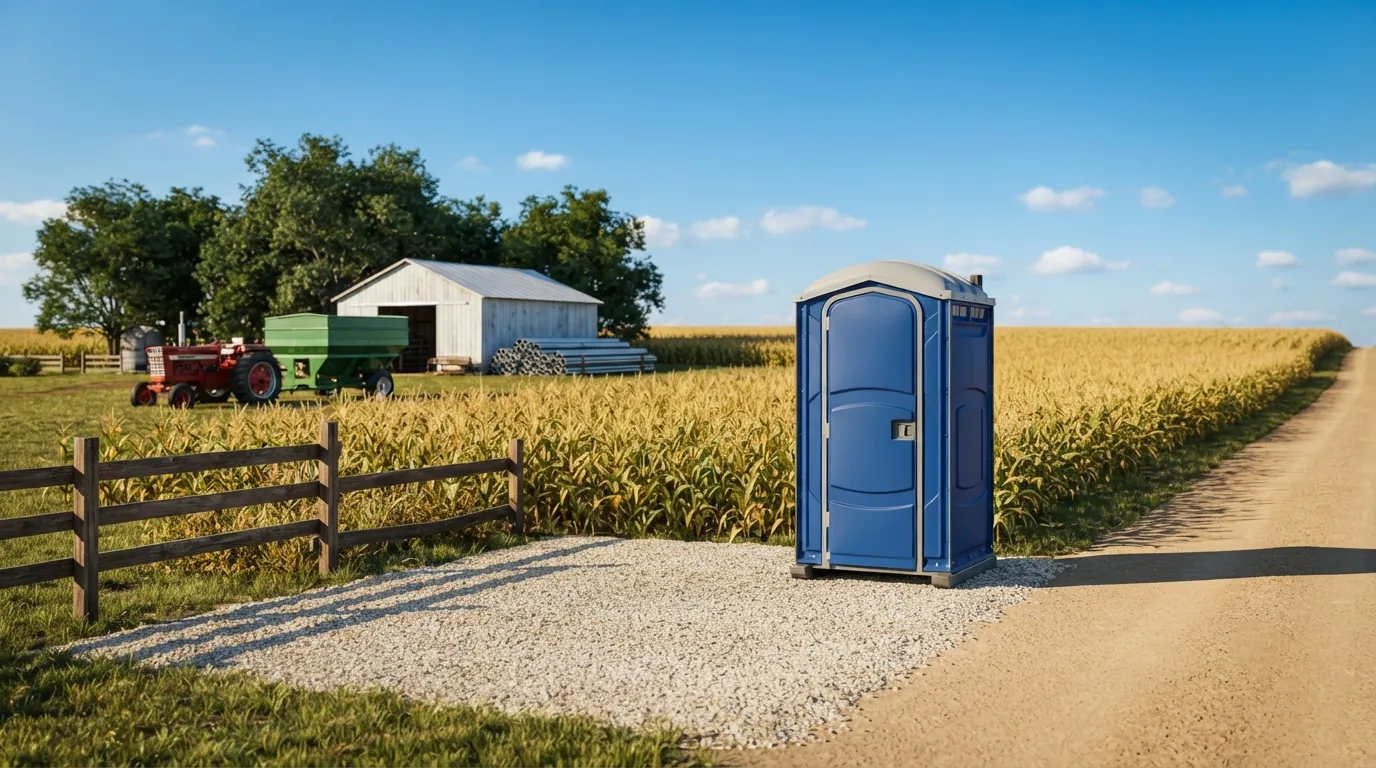
Standard units are the default. A standard porta potty rental holds 60 to 70 gallons and measures about 44 by 48 inches on the ground, small enough to place on a field edge, a gravel turnout or the shoulder of a farm lane without needing a graded pad. Racine Porta Pros can deliver to sites 4.9 miles west toward Mount Pleasant or 7.7 miles northwest toward Caledonia without a special trip charge structure, since farm delivery in Racine County follows the same route logic as any other job.
For bigger operations, a bank of units on skids works better than scattering single toilets across a property, because service trucks can hit them all in one pass under the weekly interval baseline set by ANSI/PSAI Z4.3. If workers need a step up in comfort during a long season, a deluxe flushable porta potty adds a flush mechanism and a nicer interior, and for farm stands or agritourism events drawing the public, an ADA accessible porta potty may be required. ADA Standards section 213.2 requires at least 5 percent of any cluster of single-user units to be accessible, with a minimum of one, whenever the public is using them.
Farms running septic systems for a farmhouse or employee housing should also plan ahead: a typical 1,000 gallon residential tank gets pumped every 3 to 5 years depending on household size, and septic pumping service can be scheduled alongside restroom delivery so one visit covers both. Dairy operations with wash-down water or milk house waste sometimes need grease trap pumping as well, since fats and solids get pumped once they hit 25 percent of the liquid depth in the interceptor.
| unit | duration | typical price |
|---|---|---|
| standard | day | $150 |
| standard | week | $200 |
| standard | month | $200 |
| ada | week | $185 |
Why does walk distance matter for field crews?
Because OSHA 1928.110 ties the facility requirement to a quarter mile radius, not just a headcount. A single restroom bank at the farm entrance does not satisfy the rule if crews are working a back forty a mile away. Racine Porta Pros maps out field boundaries before quoting so units land where the quarter mile actually holds up, and multi-unit placements get staggered across large parcels instead of clustered in one spot. This is also where a porta potty placement guide helps, since ground stability and truck access differ a lot between a mowed field edge and a muddy irrigation road.
Racine growers running seasonal crews should also think about winter and shoulder-season use. Units left out during a Wisconsin cold snap need different servicing, and porta potty in winter covers what changes. For operations that run events, like a pumpkin patch or corn maze drawing public traffic off the farm, farm and agricultural restrooms planning should fold in the same accessible-unit math used for festival restroom rental or county fair restrooms jobs, since the public counts differently than employees under OSHA.
How many toilets does a 15 person harvest crew need?
One toilet facility covers a crew of 15, since OSHA 1928.110 sets the threshold at one per 20 hand-labor employees. Pair it with a handwashing station nearby. If the crew splits across two fields more than a quarter mile apart, plan on two units instead of one.
Do farms need separate handwashing stations from toilets?
Yes, in practice. Field sanitation rules pair water, toilets and handwashing together, and OSHA 1926.51(f)(1) specifically requires washing facilities where pesticide or herbicide handling is happening. A standalone handwashing station rental near mixing areas covers that even when a toilet sits elsewhere.
Can Racine Porta Pros service units across multiple fields?
Yes. Weekly service follows the ANSI/PSAI Z4.3 baseline interval, and multiple field locations get grouped into one route. Farms near Kenosha, 11.7 miles south of Racine, or Oak Creek, 14.6 miles north, fall within normal delivery range without extra routing complexity.
What size tank do farmhouse septic systems usually need pumping?
A typical residential tank runs around 1,000 gallons and gets pumped every 3 to 5 years, depending on tank size and household headcount. Farms with additional employee housing or a milk house should check both the septic tank pumping cost and interval more often.
Does hand sanitizer meet the handwashing requirement?
No. 29 CFR 1910.141(d)(2) requires soap and towels or a hand drying device at washing facilities; hand sanitizer alone does not satisfy it. A hand sanitizer station rental works as a supplement, not a replacement, for a proper wash station.
Next step
Get a delivery date
Tell us the address, the dates and the headcount. We size the order and confirm the route.